

The true impact and role of AI in shaping our work future
AI has evolved to be more than a tool for solving engineering problems and developing tech solutions. It is now a universal tool. Whether most people feel comfortable using it (or know how to) is a great question. How fast they will get comfortable with it is even more critical. It is one of the most significant performance improvement tools to arise in the last decades, so it is a matter of adapting or going extinct. Further, will business leaders use it to improve the workplace or merely reduce headcount?
This article will discuss those questions. I will also try to convince you that AI is an indispensable tool for the workspace of the future — or, really, the present times.
A Brief Overview of Data Science Evolution
Only a few years back, we began to notice something intriguing. Engineers and scientists, when equipped with the right mindset and profile, morphed into exceptional consultants. Over time, these professionals began to incorporate their exact science skills into consultancy work. This integration ranged from data analysis to statistics and slowly evolved into more intricate applications, such as market predictions and macro and microeconomic forecasts. This was the birth of data science and the journey that led us to embrace machine learning. In essence, machine learning involves using data to train AI models to solve problems, a process that has become more efficient and powerful over time.
Like computers in the late 1970s, AI has evolved into a universal tool. In the 70s, people other than computer engineers had to learn how to use and adapt to computers. Now, the same is happening with AI. But are they ready for it? It is clearly a game changer regarding work performance, but how fast can people adapt and embrace this evolution?
Well, apparently, it is more than a revolution and a performance-improving tool: it is a must for the future of work if we intend to keep improving our lives.
Market Challenges and Solutions
Recent research from Indeed, Glassdoor, and data sourced from the World Bank [1] highlighted a concerning trend: a significant decline in available labor. The primary reason is demographics, with the world’s population aging. This demographic challenge results in hiring becoming more challenging, labor costs increasing, and heightened demands on the workforce.

Fewer people of working age mean the supply of workers will dwindle. Combine this aging population with other trends, such as reduced immigration, and the stage is set for chronic recruiting challenges.
Indeed & Glassdoor’s Hiring and Workplace Trends Report, 2023 [1]
Furthermore, the active labor force percentage is in decline in most significant economies, even China. This trend propels the idea of machines replacing human labor, especially as the aging population requires support.
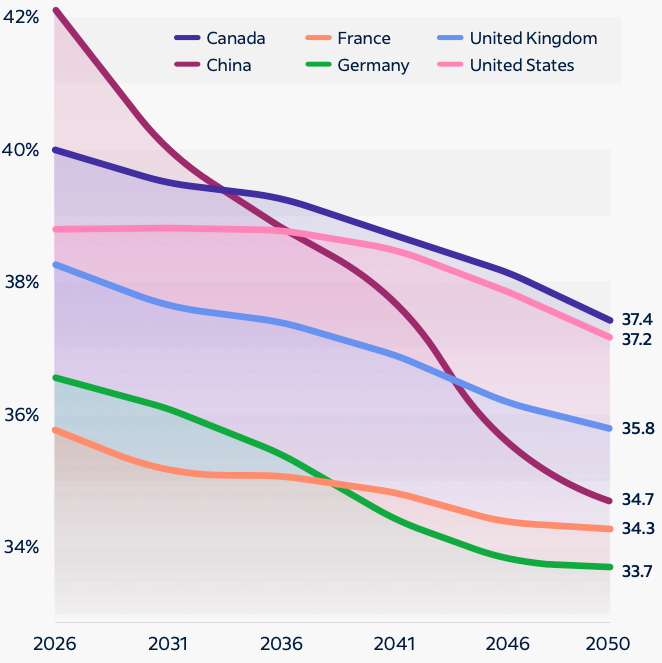
However, instead of simply replacing humans, technology, particularly AI, can amplify productivity without causing unemployment. Given the current labor shortage, enhancing productivity using technology may be our best solution.
An aging world needs a workforce large enough, or performatic enough, to maintain it. AI can be the solution.
The AI potential and a new skill set
A recent research by LinkedIn[2] emphasized the potential of AI, especially generative AI, to create content such as images, audio, and text. They found that nearly half of American executives see AI as a means to boost productivity significantly, and 44% plan to increase their AI usage in the coming year. The research also shows that people are developing their AI use skills steadily, with people adding AI-related skills to their LinkedIn profiles.
The following image shows how AI skills have been proliferating across the world. As expected, some countries show a more steady advance than others, but there is a clear worldwide trend. LinkedIn users from all around the globe have been adding AI-related skills to their profiles at a fast pace.

Job postings referencing new AI technologies also are climbing rapidly: The share of global English-language job postings mentioning GPT or ChatGPT increased 21x since November 2022. Professionals and businesses are starting to embrace AI-assisted technologies, such as ChatGPT, in their daily work and adapt their processes.
Future of Work Report AI at Work, August 2023. [2]
In the US, the Technology, Information, and Media sector unsurprisingly holds the predominant portion of AI-skilled individuals, at 2.2%. This is substantially higher compared to sectors like Education at 1.2%, Professional Services at 0.9%, Financial Services at 0.9%, and Manufacturing trailing at 0.8%. However, a paradigm shift is evident as other industries show accelerated adaptation rates. Analyzing the trajectory at which AI skills are being integrated into professional profiles, it’s surprising to see that individuals within Financial Services (30x), Retail (29x), and Wholesale (24x) are incorporating AI competencies at a rate surpassing even Technology, Information, and Media (11x).
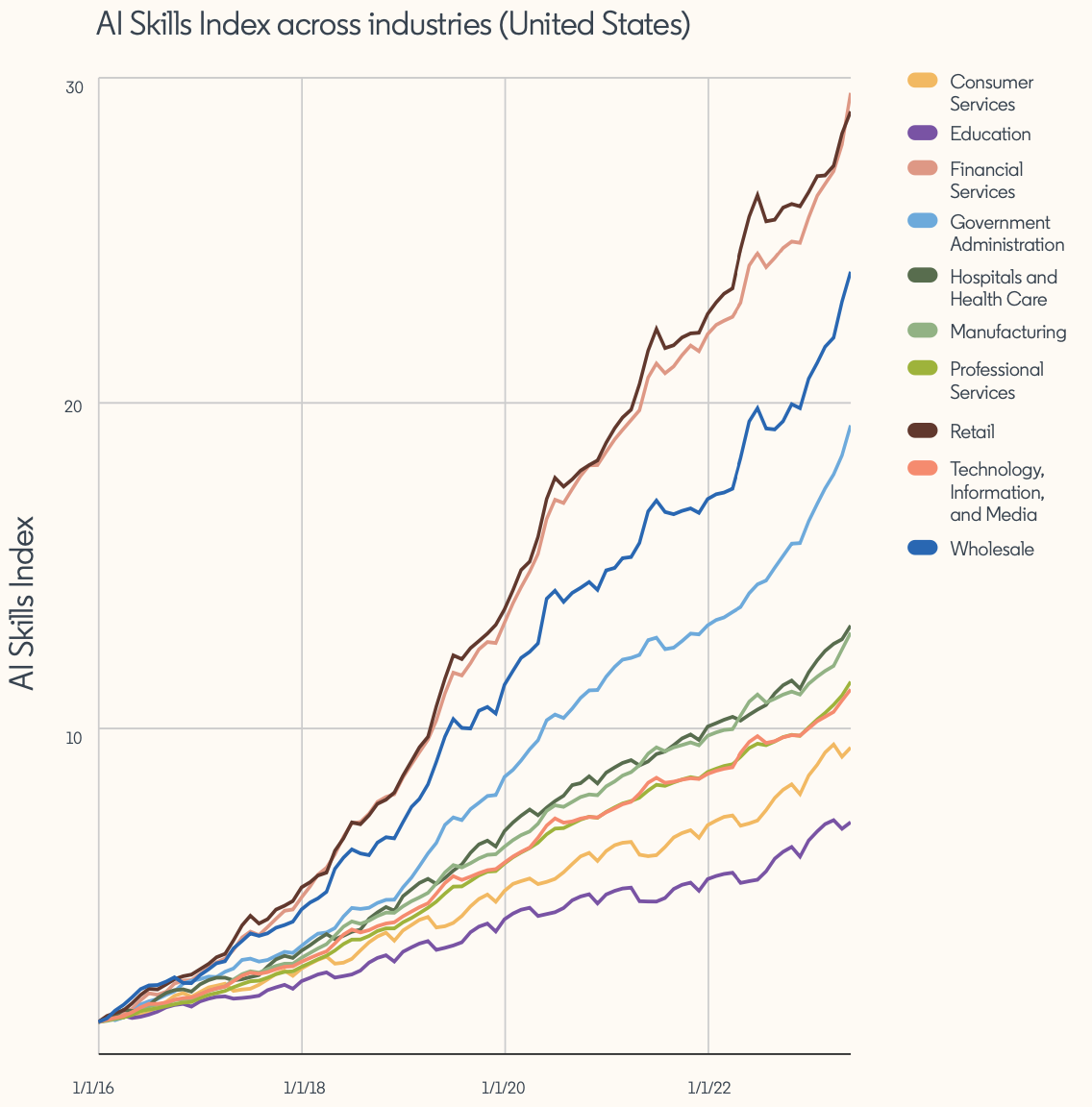
Upon examining ten prominent US industries (see image above), Financial Services emerges distinctively, being the sole sector where the proportion of AI-skilled professionals and the rate of AI skill acquisition surpass industry averages. This trend highlights the potential of non-traditional tech sectors not only being early AI adopters but also important contributors to AI-driven innovation in the workplace.
AI as a tool
Another survey by Microsoft [3] showed three main insights:
- Technical debt is costing innovation: The research identified that the technical debt in the tech sector is stunting innovation. Companies must invest in upskilling their workforce and upgrading their tech stacks to capitalize on AI’s potential fully.
- There is an alliance between AI and employees: Contrary to the fear of AI taking over jobs, the research showcased a beneficial relationship between AI and workers. There’s a clear indication that workers are receptive to AI and actively looking for ways AI can complement their roles.
- It is imperative to learn AI: As AI becomes more integrated into various sectors, there’s a growing need for everyone, from tech professionals to non-tech roles, to understand and use AI as a tool. This doesn’t mean everyone should become AI developers, but having a foundational understanding of AI’s capabilities and applications can significantly augment job roles.
The research offers a counter-narrative to the fear of AI replacing jobs. It revealed that while 49% of individuals fear job loss due to AI, about 70% are comfortable delegating tasks to AI to reduce their workload and enhance productivity. These numbers show that people are more motivated by improving productivity than they fear AI-induced job loss.
Not only did 3 in 4 people share that they would be comfortable using AI for administrative tasks (76%), but most people also said they would be comfortable using it for analytical (79%) and even creative work (73%).
2023 Work Trend Index: Annual Report: Will AI Fix Work? [3]
Business leaders feel the same: the research indicates that, from all of the capabilities and opportunities brought by AI, the idea of using it to reduce headcount is far from the most common one on the heads of employers. Indeed, executives prefer to use it as a tool to improve performance, as the following image depicts. Further, business leaders are focused on finding ways of using AI to improve their employee’s well-being, eliminating their time spent on low-value and boring activities, acquiring more knowledge, and increasing inclusivity.

“Amid fears of AI job loss, business leaders are 2x more likely to choose ‘increasing employee productivity’ than ‘reducing headcount’ when asked what they would most value about AI in the workplace.”
2023 Work Trend Index: Annual Report: Will AI Fix Work? [3]
Hype?
The Gartner Hype Cycle, an annual analysis, visually represents the maturity, adoption, and application of specific technologies, helping industry leaders discern between what’s mere hype and what holds genuine promise.
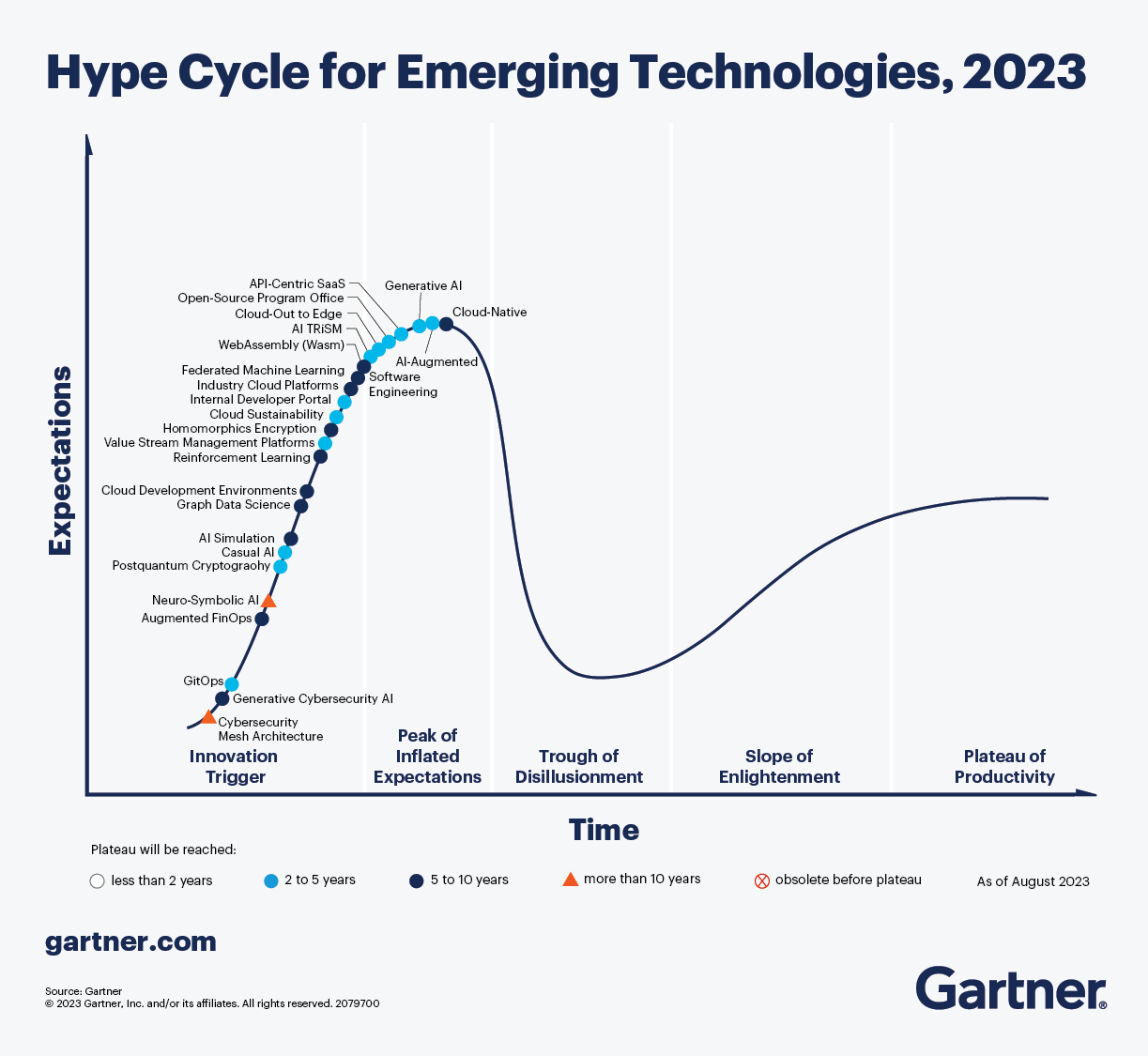
This year’s curve places technologies like generative AI and cloud computing at its peak of inflated expectations. This positioning suggests that these technologies are currently receiving a lot of attention and thus might be surrounded by over-enthusiasm. There’s a risk of potential disillusionment in the short term. However, as the curve historically indicates, after this potential desilusion, a period of enlightenment and productivity typically follows. For industry leaders and innovators, understanding this cycle can be invaluable in strategizing investments and anticipating market shifts.
Concluding thoughts
The interplay between AI and the labor market, accentuated by demographic shifts and technological advancements, paints a complex but promising picture. There’s a balance between AI’s genuine potential and its inflated expectations. The future of work is undoubtedly evolving, with AI playing an important role. However, while the technology offers great possibilities for improving productivity and filling labor gaps, it’s essential for industry leaders to approach it with a well-informed perspective, tempering enthusiasm with practicality. As we navigate this AI-augmented landscape, continuous learning, adaptability, and strategic foresight will be paramount for individuals and organizations. This technology, as any, has its limits. Let us hope we’ll reach it wisely.
References
[1] Indeed & Glassdoor’s Hiring and Workplace Trends Report, 2023. Link: https://www.indeed.com/lead/indeed-glassdoor-hiring-and-workplace-trends-report-2023
[2] Future of Work Report AI at Work, August 2023. Link: https://economicgraph.linkedin.com/research/future-of-work-report-ai
[3] 2023 Work Trend Index: Annual Report: Will AI Fix Work? Link: https://www.microsoft.com/en-us/worklab/work-trend-index/will-ai-fix-work
 GennSev